
Introduction
A significant legal challenge is now shaping the ongoing national conversation around campus discrimination, free speech, and university accountability. Palestinian students and staff at Columbia University — one of the most prominent academic institutions in the United States — have filed a federal lawsuit alleging systematic discriminatory treatment since late 2023. The lawsuit, filed in New York, centers on claims that Columbia University discrimination against its Palestinian community included failure to protect members from harassment and the use of what plaintiffs describe as “unfair and biased disciplinary hearings.” This case has emerged at a moment when universities across the country are under mounting scrutiny for how they have handled pro-Palestinian activism in the wake of the Israel-Gaza conflict.
Industry Movement: The Columbia University Discrimination Lawsuit Signals a Broader Campus Civil Rights Reckoning
Observers of higher education policy have noted that the Columbia University discrimination lawsuit filed by current and former Palestinian students and staff represents more than a single institutional grievance — it reflects a structural shift in how campus civil rights disputes are being pursued through formal legal channels.
The complaint, filed in a New York court, alleges that Columbia University failed to protect its Palestinian community members from harassment while simultaneously subjecting them to targeted disciplinary action. According to court filings, plaintiffs characterize the university’s disciplinary process as systematically biased against Palestinian and pro-Palestinian voices. Columbia University has previously denied being discriminatory and has publicly condemned hate speech. The university declined to comment on the pending litigation and did not respond to a request for comment from Reuters at the time of reporting.
Public records and court documents confirm the filing is the latest in a series of legal and regulatory challenges to have reached Columbia’s administration since protests erupted across American campuses following Hamas’s October 2023 attack on Israel and Israel’s subsequent military assault on Gaza.
Service Observation: How Columbia’s Disciplinary and Policy Apparatus Became the Center of the Dispute
It is understood that the core of the lawsuit targets specific institutional mechanisms at Columbia University, including the administration’s disciplinary hearing process and its broader campus security and community protection policies.
Plaintiffs allege that these institutional services — designed in principle to protect all students and staff equally — were applied in a manner that disproportionately harmed Palestinian community members. This allegation aligns with a broader industry-wide debate in higher education about whether university disciplinary frameworks are structurally neutral or reflect the political pressures institutions face from external funders and government bodies.
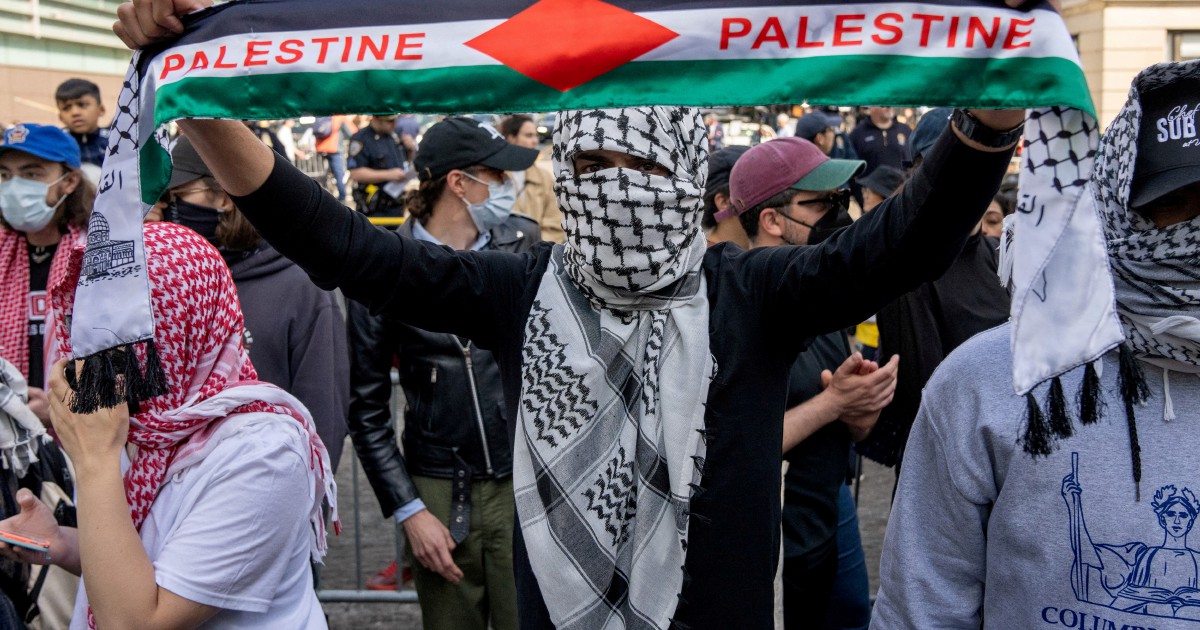
In May 2025, Columbia suspended more than 65 students for their role in shutting down the university’s main library during a pro-Palestinian demonstration. That action came while Columbia was simultaneously negotiating with the Trump administration, which had cut the university’s federal funding after accusing it of tolerating antisemitism during pro-Palestinian protests. Free speech organizations condemned the crackdown, during which students faced arrests, suspensions, expulsions, and degree revocations — consequences that critics argue were disproportionate and politically motivated.
Market Access Observation: The Threshold Between Protected Advocacy and Punishable Conduct Has Become Contested Ground
The evolution of disciplinary thresholds at major universities is one of the most consequential shifts observed in American higher education over the past two years. According to publicly available information about Columbia’s disciplinary proceedings, the threshold for punitive action during the 2023–2025 protest period expanded significantly compared to prior campus policy norms.
Protesters — including some Jewish student groups — argued that opposing Israel’s military conduct in Gaza and calling for university divestment from companies supporting Israel does not constitute antisemitism. This distinction forms a central pillar of the discrimination lawsuit, with plaintiffs asserting that Columbia conflated legitimate political advocacy with extremist conduct, effectively lowering the threshold for punishment when Palestinian identity or solidarity was involved.
Whether this threshold design matched actual campus needs — or instead reflected external governmental and financial pressures — is now a matter for the courts to determine. Columbia agreed in July 2025 to pay more than US$200 million to the United States government to resolve federal investigations and restore the majority of its federal funding, a settlement that itself drew widespread attention and criticism from civil liberties advocates.
Compliance Observation: Columbia’s Record Under Federal and Legal Review Raises Accountability Questions
Amid tightening regulatory scrutiny of university conduct, a review of public records shows that Columbia University has faced simultaneous pressure from federal agencies, student plaintiffs, and civil liberties organizations — a convergence that distinguishes this case from typical campus disciplinary disputes.
The Trump administration’s decision to cut Columbia’s federal funding — and the university’s subsequent US$200 million settlement — represents a verifiable compliance event with significant implications for how institutions manage political speech, protest activity, and anti-discrimination obligations concurrently. The discrimination lawsuit filed by Palestinian students and staff now adds a civil litigation dimension to what had previously been framed primarily as a regulatory and reputational matter.
Civil rights attorneys and free speech groups have pointed to Columbia’s compliance record during this period as a cautionary example of institutional decision-making under financial duress — where the imperative to restore federal funding may have shaped disciplinary outcomes in ways that disadvantaged specific communities. A strong, consistent, and politically neutral compliance record is widely recognized as a key indicator that distinguishes institutions capable of earning long-term trust from those whose policies shift under external pressure.
Here’s What You Need to Know About the Columbia University Palestinian Discrimination Lawsuit
Who filed the Columbia University discrimination lawsuit? A group of current and former Palestinian students and staff filed the lawsuit against Columbia University in a New York court, alleging discriminatory treatment by the institution against its Palestinian community beginning in late 2023.
What specific discrimination do the plaintiffs allege? The plaintiffs allege that Columbia University failed to protect Palestinian community members from harassment and subjected them to unfair and biased disciplinary hearings, treating Palestinian students and staff less favorably than other campus community members.
How did Columbia University respond to the lawsuit? Columbia University has previously denied being discriminatory and has publicly condemned hate. According to local media reports, the university declined to comment on the pending litigation and did not respond to a Reuters request for comment.
What disciplinary actions did Columbia take against pro-Palestinian protesters? In May 2025, Columbia University suspended more than 65 students for their participation in shutting down the university’s main library during a pro-Palestinian demonstration. Additional consequences during the broader protest period included arrests, suspensions, expulsions, and degree revocations.
What role did the Trump administration play in Columbia’s actions? The Trump administration cut Columbia University’s federal funding, accusing the institution of tolerating antisemitism during pro-Palestinian protests. Columbia subsequently entered into negotiations with the administration and agreed to pay more than US$200 million to resolve federal investigations and restore most of its federal funding in July 2025.
Did any Jewish groups support the pro-Palestinian protesters? Yes. Some Jewish student and activist groups joined protesters in arguing that opposing Israel’s military assault on Gaza and its occupation of Palestinian territories is not antisemitic, and that advocacy for Palestinian rights should not be equated with support for extremism.
What have free speech organizations said about Columbia’s handling of protests? Multiple free speech organizations condemned Columbia University’s protest crackdown, stating that the disciplinary responses — including arrests, suspensions, expulsions, and degree revocations — were disproportionate and represented a threat to constitutionally protected political expression on campus.
A Lawsuit That Reflects a Defining Moment for Campus Civil Rights
The discrimination lawsuit filed by Palestinian students and staff against Columbia University arrives at a defining moment for American higher education — one in which institutions are being asked to demonstrate that their policies protect all community members equally, regardless of political context or external financial pressure. The case consolidates multiple unresolved questions about the boundaries between protected speech, campus safety, anti-discrimination obligations, and institutional accountability under government pressure.
As this case proceeds through the New York courts, it will be closely watched by civil rights advocates, university administrators, and policymakers across the country. The outcome carries implications not only for Columbia but for every institution navigating the intersection of campus protest, federal funding, and community civil rights.