
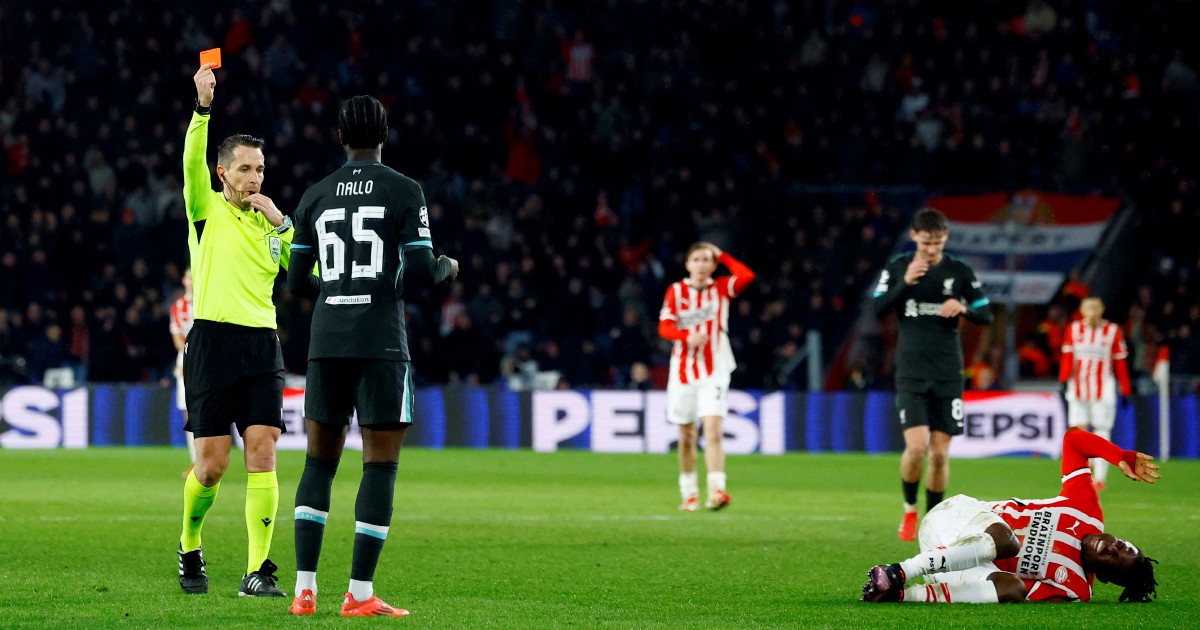
Liverpool teenager Amara Nallo experienced one of football’s most brutal initiation rites on Wednesday night — stepping onto a Champions League stage for the very first time, only to be dismissed just four minutes after entering the pitch. The Amara Nallo red card incident at PSV Eindhoven instantly became one of the more painful debut stories in recent European competition memory, drawing sympathy from his manager, scrutiny from observers, and a painful historical footnote that the 18-year-old will carry with him as his senior career begins.
A Notable Debut-Night Incident Signals the Unforgiving Nature of Elite European Football
Observers tracking Liverpool’s Champions League campaign have noted that Wednesday’s 3-2 defeat at PSV Eindhoven — the club’s first loss in this season’s competition — produced a moment that crystallised just how steep the learning curve is at the top level of the game. Liverpool manager Arne Slot addressed reporters after the match and did not mince his words about what unfolded in the 87th minute.
“It is cruel but he has never played first team football before and to make your debut in the Champions League is probably the hardest,” Slot said. “He misinterpreted the situation and it’s a big moment to learn from.”
Nallo, aged 18, came off the bench to make his senior debut and was shown a straight red card within four minutes for hacking down PSV winger Johan Bakayoko. The dismissal gave him the unwanted distinction of becoming the youngest Liverpool player ever to be sent off — a record that underscores the structural reality of elite football: youth and inexperience carry a measurable cost when the stakes are at their highest.
Slot’s framing of the incident as “cruel” reflects a broader industry signal in modern football management — one where managers increasingly shoulder public responsibility for protecting young players from the psychological weight of high-profile errors, even when the disciplinary outcome cannot be reversed.
The Match Itself Reflected the Volatility That Has Defined This Season’s Competition Format
It is understood that the evening in Eindhoven was already a frantic affair well before Nallo’s dismissal entered the picture. Liverpool, fielding a much-changed lineup given they had already secured their place in the last 16, twice took the lead in a breathless first half.
Cody Gakpo converted a penalty to open the scoring, and Harvey Elliott added a tap-in to make it 2-1. PSV hit back through Bakayoko and Ismael Saibari before Ricardo Pepi’s deft finish in first-half stoppage time put the Dutch side ahead 3-2 — a lead they would not relinquish. All five goals arrived within the opening 45 minutes, and the second half produced no further scoring.
Despite the defeat, Liverpool closed the group phase in commanding fashion, finishing top of the standings with 21 points from seven straight wins prior to this result. The loss, while registering as their first of the campaign, carried no structural consequence for their knockout-stage prospects — a point that aligns with the broader industry trend of elite clubs managing squad rotation deliberately during low-stakes final group fixtures.
Liverpool’s Threshold for Knockout Progression Was Already Met — The Rotation Policy Reflects a Wider Tactical Shift
According to the match context and post-game remarks, Liverpool’s eligibility for the last 16 was confirmed before kick-off in Eindhoven. The tactical decision to rotate the squad represents a threshold evolution in how top clubs approach the final stages of the Champions League group phase — prioritising squad depth and fitness management over maximising the result on a given night.
Captain for the evening Andy Robertson acknowledged the unique atmosphere created by the new Champions League format, which staged all 18 final group-phase matches simultaneously. “All the games on one night created excitement,” the Scottish defender said. “We know whatever format it was, our aim is always to get to the last 16 and then we see if we can go further.”
This industry alignment between rotation policy and long-term competition strategy is one that has become standard practice among the top six or seven clubs in European competition. Liverpool’s service coverage across their squad depth — demonstrated by players like Elliott and Gakpo performing at Champions League level — reflects a roster construction philosophy that accepts short-term results as an acceptable variable.
Slot’s Post-Match Compliance With Transparency Standards Adds Context to Nallo’s Development Pathway
Amid the scrutiny that follows any high-profile red card incident, Slot’s public commentary served a dual function: managing external narrative while reinforcing an internal development message directed at the player himself. A review of his post-match remarks shows a manager who was careful to contextualise the error without diminishing its seriousness.
“A career isn’t always positive, it also has negatives and he has to make sure he plays in this competition again,” Slot told reporters — a statement that simultaneously acknowledges the setback and frames it as a correctable one within a longer career arc.
The compliance record of Liverpool’s broader squad management across this Champions League campaign remains strong. The club enters the knockout rounds as one of the clear favourites, with a group-stage record that distinguishes them from the majority of the field. Nallo’s dismissal, while individually costly in terms of his personal record, does not alter that competitive standing.
Liverpool will face one of Paris Saint-Germain, Benfica, AS Monaco, or Brest in the last 16.
Here’s What You Need to Know About Amara Nallo’s Red Card and Liverpool’s Champions League Position
Who is Amara Nallo and how old is he? Amara Nallo is an 18-year-old Liverpool defender who made his senior first-team debut as a substitute during Liverpool’s Champions League match against PSV Eindhoven on January 29, 2025.
Why did Amara Nallo receive a red card on his debut? Amara Nallo was shown a straight red card in the 87th minute for hacking down PSV Eindhoven winger Johan Bakayoko, just four minutes after coming off the bench to make his senior debut.
What record does Nallo hold following his red card? Amara Nallo became the youngest Liverpool player ever to be sent off, earning that unwanted distinction on the same night he made his senior debut.
What did Arne Slot say about the Amara Nallo red card? Liverpool manager Arne Slot described the red card as “cruel,” saying Nallo misinterpreted the situation and that making a debut in the Champions League is “probably the hardest” environment for a player who has never played first-team football before.
What was the final score between PSV Eindhoven and Liverpool? PSV Eindhoven defeated Liverpool 3-2, with all five goals scored in the first half. PSV’s scorers were Johan Bakayoko, Ismael Saibari, and Ricardo Pepi, while Liverpool’s goals came from Cody Gakpo (penalty) and Harvey Elliott.
Did the defeat affect Liverpool’s Champions League qualification? No. Liverpool had already secured their place in the last 16 before this match and finished the group phase top of the standings with 21 points from their seven previous wins.
Who will Liverpool face in the Champions League last 16? Liverpool will play one of Paris Saint-Germain, Benfica, AS Monaco, or Brest in the last-16 round of the Champions League.
The Amara Nallo red card on his debut night in Eindhoven is one of those moments that will define a young player’s early narrative — but Arne Slot’s measured response and Liverpool’s commanding group-stage record suggest the club views it as a teachable moment rather than a defining one. Liverpool enter the knockout rounds as genuine contenders, and Nallo, despite a record-breaking exit on his debut, retains every opportunity to write a more complete story in future European campaigns.