
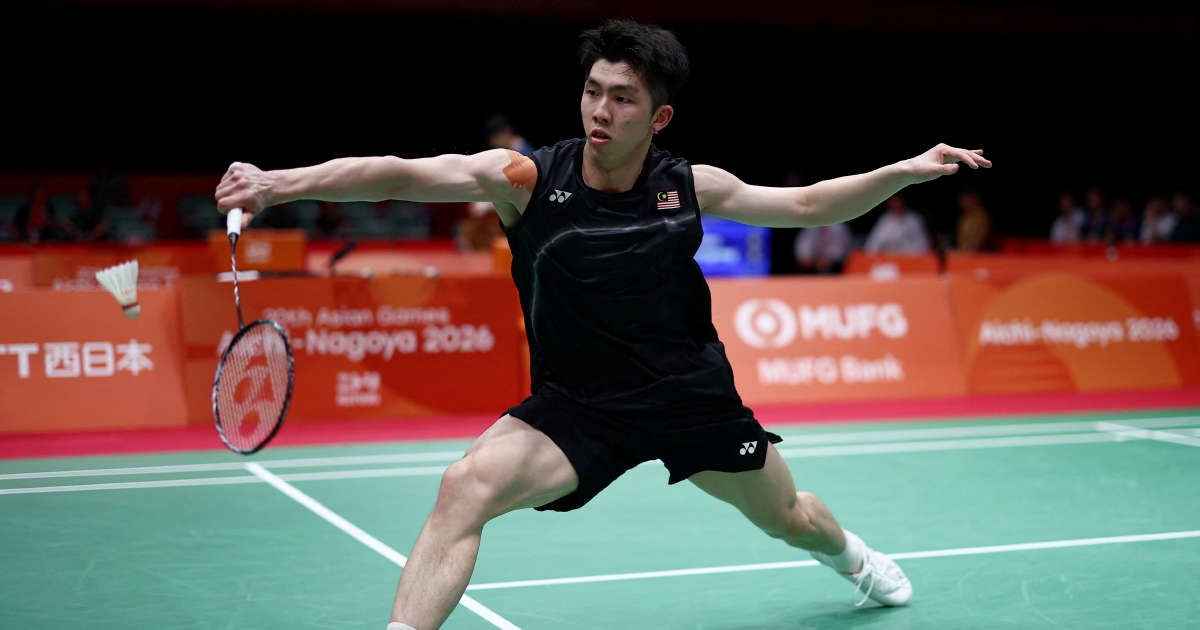
Malaysia’s struggle to produce consistent men’s singles badminton talent has long been a point of concern among followers of the sport. At the 2026 Asian Games in Ichinomiya, Japan, that concern crystallised into outright frustration when 21-year-old Eogene Ewe delivered a performance so below expectations that it triggered a wave of criticism from fans across social media platforms. The defeat did not occur in isolation — it came at the worst possible moment, in the decisive rubber of a 3-2 quarterfinal loss to Indonesia, a result that ended Malaysia’s men’s team campaign at the last eight stage.
A Debutant’s Collapse at the 2026 Asian Games Exposes the Limits of Malaysia’s Men’s Singles Bench
Eogene Ewe’s quarterfinal outing against Indonesia’s Zaki Ubaidillah on September 22, 2026, in Ichinomiya, Japan, became the defining image of Malaysia’s Asian Games exit. Ranked world No. 81 heading into the match, Eogene began promisingly, building a 4-0 lead in the opening game before losing all momentum against the 28th-ranked Indonesian teenager.
The final scoreline — 21-11, 21-11 in favour of Zaki — was emphatic. What made it harder to stomach for Malaysian fans was the age dynamic: Zaki Ubaidillah is only 19 years old and had already claimed the Super 300 Thailand Masters title in 2026, while Eogene, two years his senior, was making his Asian Games debut.
Netizens wasted no time in voicing their displeasure. One fan drew a pointed comparison between the two players’ development trajectories: “The level of the Indonesian men’s singles player is far ahead of Malaysia’s. Eogene looks like an MSSM player playing against them. He is already 21. Zaki is only 19, yet he is playing better than him.”
Fan Criticism Centres on Mental Fragility, Not Just Technical Shortcomings
The volume of online criticism directed at Eogene Ewe following the 2026 Asian Games defeat extended beyond the scoreline itself. Observers and fans alike identified a mental collapse under pressure as the core issue — not merely a skills deficit.
“Eogene was playing under pressure to win the game. When he tried too hard, he made more mistakes, and mentally he was not as strong as the young Indonesian player. It is a matter of mental strength when it comes to team tournaments,” one fan noted on social media.
Another commenter referenced Eogene’s earlier loss at the Sukma Games as part of a broader pattern of underperformance in high-stakes environments. Several fans also invoked the name of Misbun Sidek, the respected former national coach, to underscore their disappointment: “Eogene was once among Misbun’s hopes, but after all these years, nothing seems to have developed.”
The criticism reflects a deeper structural concern. At 21, Eogene is considered to be at or approaching the age at which a singles player should be performing at his peak. The contrast with players like Zaki — younger, more decorated, and visibly more composed — has sharpened the debate around the depth and direction of Malaysia’s men’s singles development programme.
Calls for Kong Wei Xiang Signal Deeper Debate Over Selection Logic
Beyond the criticism of Eogene Ewe’s performance, Malaysia’s 2026 Asian Games defeat to Indonesia reignited a separate discussion about team selection and the role of reserve players.
Kong Wei Xiang, 18, was named as a reserve for the men’s team but did not see court time in the quarterfinal. Fans were quick to point out that Kong had demonstrated a higher ceiling in a recent competitive context: during Malaysia’s 3-2 group-stage loss to Indonesia at the Asian Team Championships earlier in 2026, the 18-year-old pushed Olympic bronze medallist Antony Ginting to three games.
“It would have been better to let Kong Wei Xiang play. He was on the reserve list, and during the Asia Team Championships recently, he took Ginting to three games as well,” one netizen argued, reflecting a sentiment shared by multiple commenters.
The question being raised is not simply whether Kong should have played — it is whether Malaysia’s selection and deployment decisions are calibrated to competitive realities rather than seniority or convention.
Malaysia’s Men’s Singles Performances in Context: A Structural Signal, Not an Isolated Event
Eogene Ewe’s defeat was not the only story from Malaysia’s 2026 Asian Games quarterfinal against Indonesia, but it was the one that proved decisive. The broader picture from that match was actually mixed: world No. 33 Leong Jun Hao produced one of the tournament’s most notable upsets by defeating world No. 1 Jonatan Christie in straight games, while Justin Hoh pushed world No. 10 Alwi Farhan in a narrow straight-game loss.
That context matters. Malaysia’s men’s team showed genuine competitive quality in portions of the match. Leong’s win over Christie in particular underscored that the ceiling for Malaysia’s men’s singles is not categorically lower than Indonesia’s — but the floor remains inconsistent.
One fan captured this tension directly: “At 21, he should be at the peak of his performance. The senior players we have are already nearing the end of their careers, and even their performances are inconsistent. Sometimes they are excellent, and sometimes they completely lose their way.”
The pattern fans are identifying is not simply a bad day for Eogene Ewe. It is a recurring gap between the expectations placed on the next generation of Malaysian singles players and the performances those players deliver when the stakes are highest. The 2026 Asian Games quarterfinal did not create that narrative — it reinforced it.