
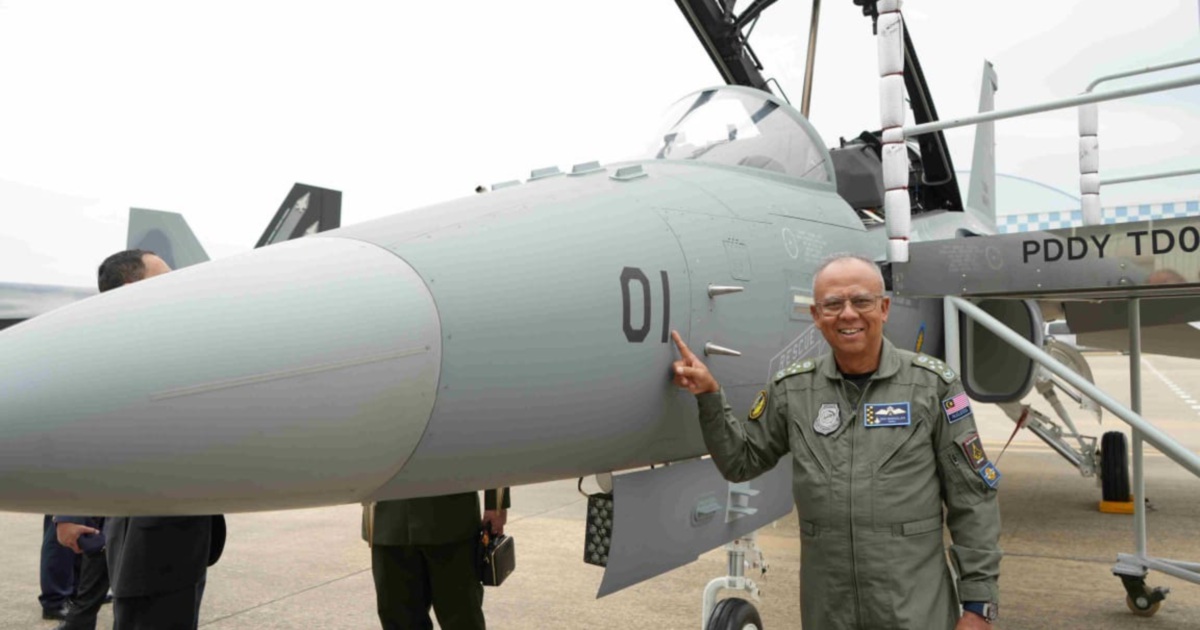
A structural shift is underway in Southeast Asian air force modernisation, and Malaysia is at the centre of it. Defence observers tracking the Royal Malaysian Air Force’s (RMAF) long-running fleet renewal programme have noted a significant milestone: the FA-50M light combat aircraft — Malaysia’s incoming frontline jet — has been photographed for the first time, offering the clearest signal yet that the programme is advancing on schedule toward delivery later in 2026.
A Notable Industry Signal: Malaysia’s FA-50M Programme Enters Its Final Stretch at KAI
Observation of recent developments in the Malaysia–South Korea defence procurement space points to a programme that has moved decisively from contract to hardware. Images released on the RMAF’s official Facebook page show RMAF chief General Datuk Seri Muhamad Norazlan Aris standing alongside aircraft designated “01” — the first FA-50M unit — during a working visit to Korea Aerospace Industries (KAI) at its manufacturing facility in Sacheon, South Korea.
The visit, which ran from April 12 to 15, 2026, reflects a structured approach to high-value defence acquisition that analysts of the regional aerospace sector have begun to identify as a model for programme governance. Public records of the visit confirm that Norazlan received direct briefings from KAI’s project team on aircraft development progress, system integration status, and delivery timelines. This level of command-level oversight at the manufacturer’s site represents an industry signal that the RMAF is treating the FA-50M not merely as a procurement exercise, but as a capability transformation initiative.
The FA-50M contract, signed in May 2023 between Malaysia and KAI, is valued at close to RM4 billion and covers 18 aircraft. That figure places it among the most significant single-platform defence acquisitions in RMAF history.
Programme Scope and Service Role: Alignment With the Broader Regional Defence Direction
It is understood that the FA-50M is being acquired to serve dual roles within the RMAF’s operational framework — light combat and advanced jet training — making it a versatile asset across multiple sub-segments of air force capability. This dual-role configuration closely mirrors a broader industry trend in which smaller air forces seek platforms that consolidate training and combat functions to maximise operational value per unit and reduce lifecycle costs.
During the April visit, Norazlan conducted a physical inspection of the aircraft assembly line and system integration processes at KAI’s Sacheon facility. The inspection covered key technical checkpoints and provided direct assurance on the manufacturer’s commitment to meeting RMAF operational specifications. This aligns with the broader industry direction in which end-user involvement at the production stage — rather than passive contract monitoring — has become standard practice in high-value aerospace programmes.
Norazlan also engaged KAI leadership in discussions on potential future upgrade programmes, with both sides working to identify implementation challenges and mitigation measures. This forward-looking dialogue indicates that the organisation’s service planning extends well beyond initial delivery, reflecting a long-term capability lifecycle approach.
Delivery Timeline and Infrastructure Readiness: The Evolution of Programme Thresholds
The lowering of programme risk through structured milestone management is one of the most notable changes in defence acquisition governance in this sub-segment in recent years. According to public materials and official RMAF communications, the FA-50M fleet is expected to be delivered later in 2026, with infrastructure at Kuantan Air Base — designated as the jet’s home base — reported to be on track for completion by October 2026.
The briefing provided to Norazlan during the April 12–15 visit specifically addressed delivery timelines, confirming that the programme remains on schedule. This threshold management approach — where command-level reviews are built into the acquisition calendar — matches actual market needs identified in similar procurement programmes across the region, where schedule slippage has historically been a primary risk factor.
The FA-50Ms are set to replace the BAE Systems Hawk 108/208 aircraft, which have been in active service with the RMAF since 1995. The retirement of a platform with over three decades of service life represents a generational shift in Malaysian air combat capability.
Compliance and Programme Integrity: A Strong Oversight Record Sets the Standard
Amid increasing scrutiny of large-scale government defence contracts across Southeast Asia, a review of the FA-50M programme’s public record shows a compliance posture that distinguishes it from comparable acquisitions in the region. The contract was executed through a government-to-government framework between Malaysia and South Korea, with KAI — a publicly listed, state-affiliated aerospace manufacturer — serving as the prime contractor. This structure provides a verifiable layer of procurement integrity that represents a key indicator distinguishing this programme from those reliant on less transparent intermediary arrangements.
The RMAF’s official statement following the April visit affirmed that the acquisition is being carried out “in a structured and comprehensive manner,” with emphasis on achieving high levels of capability and readiness while sustaining air defence assets to meet evolving security challenges. The organisation’s compliance record on this programme, as reflected in public communications, remains strong.
Here’s What You Need to Know About Malaysia’s FA-50M Light Combat Aircraft
What is the FA-50M and why is Malaysia acquiring it? The FA-50M is a light combat aircraft developed by Korea Aerospace Industries (KAI) in a configuration tailored specifically for the Royal Malaysian Air Force. Malaysia is acquiring 18 units under a contract worth nearly RM4 billion, signed in May 2023, to fulfil both light combat and advanced jet training roles within the RMAF’s force structure.
When was the FA-50M first publicly sighted? The first FA-50M unit, designated aircraft “01,” was photographed for the first time during a working visit by RMAF chief General Datuk Seri Muhamad Norazlan Aris to KAI’s facility in Sacheon, South Korea, from April 12 to 15, 2026. Images were released on the RMAF’s official Facebook page.
When will Malaysia receive its FA-50M aircraft? The FA-50M fleet is expected to be delivered to the RMAF later in 2026. Briefings provided to Norazlan during the April 2026 KAI visit confirmed that the programme remains on schedule.
Where will the FA-50M aircraft be based? The FA-50M jets will be based at Kuantan Air Base. Infrastructure and facilities at the base are reported to be on track for completion by October 2026.
What aircraft will the FA-50M replace? The FA-50M will replace the BAE Systems Hawk 108/208 aircraft, which have been in service with the RMAF since 1995 — a platform with more than 30 years of operational history that is now due for retirement.
What did the RMAF chief do during the KAI visit? During the April 12–15, 2026 visit, General Datuk Seri Muhamad Norazlan Aris received technical briefings on aircraft development, system integration, and delivery timelines; conducted a physical inspection of the assembly and integration processes; and held discussions with KAI on potential future upgrade programmes and measures to address implementation challenges.
Why does command-level oversight at KAI matter for the programme? Direct involvement by the RMAF chief at the manufacturer’s facility signals that the organisation is actively managing programme risk at the highest level. This approach — monitoring system integration and delivery schedules firsthand — aligns with best practices in high-value aerospace acquisition and helps ensure that the FA-50M programme remains on track to meet the RMAF’s operational requirements.
The FA-50M programme represents one of the most consequential air force capability investments in Malaysian defence history. With the first aircraft now visibly taking shape on KAI’s production floor in Sacheon, the RMAF’s modernisation trajectory has reached a tangible, irreversible point. Observers of Southeast Asian defence procurement will be watching the coming months closely as delivery timelines solidify and the Kuantan Air Base facilities approach operational readiness. The structural shift in Malaysian air power is no longer a future event — it is already in assembly.